LED Headlamp Lumen Claims: How to Measure Before You Buy 1,000
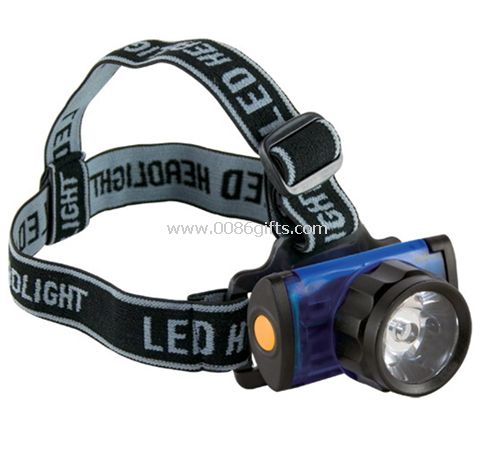
A 1,000-lumen headlamp is a claim about one moment. It is measured on fresh cells, within seconds of switch-on, with the optic at room temperature. What the buyer's customer experiences is hour two on a dark trail, in a plastic housing that has been heating up since the first minute. The gap between those two states is where returns come from.
You do not need a photometric lab to find that gap. A lux meter, a tape measure, a calculator and twenty minutes will tell you whether the claim on the box survives contact with physics, and whether a 1,000-unit order is safe.
What a lumen figure actually measures
The industry reference is ANSI/NEMA FL1, which defines output as light measured within thirty seconds of activation, and runtime as the time until output falls to ten percent of the initial reading. Both definitions are generous on purpose: they describe the peak, not the evening. A supplier quoting FL1 honestly is telling you the best thirty seconds of the product's life.
Three things inflate the number further. The emitter datasheet figure is taken at a junction temperature and drive current the finished lamp may never reach. The optic eats ten to fifteen percent before light leaves the lens. And a three-emitter lamp invites the supplier to add three datasheet maxima together as if they were measured at the lens. None of this is fraud in every case; it is the difference between a chip figure and a delivered figure, and the gap is routinely thirty to fifty percent.
Turn the beam distance into a number you can read
Beam distance is the most checkable claim on the packaging, because it reduces to a single lux reading. FL1 defines throw as the distance at which the beam falls to 0.25 lux, which is roughly moonlight. Distance in metres equals the square root of peak intensity divided by 0.25. At one metre, intensity in candela is simply the lux reading, so a lamp claiming fifty metres needs 625 candela, and your meter should read 625 lux at one metre on axis.
Set up in a dark room, put the meter at exactly one metre from the lens, aim at the hotspot centre and read the peak. Do it on fresh cells and, for anything with a zoom or focus ring, at the setting the marketing photo used. A reading of 300 lux against a fifty-metre claim is not a forty percent shortfall, it is a lamp that reaches thirty-five metres. That difference is what a customer notices at the far end of a car park.
Do the watt-hour arithmetic before anything else
Light output costs energy, and a headlamp body only holds so much of it. Three AAA alkalines give roughly five watt-hours at low drain and considerably less when pulled hard. A single 18650 lithium cell gives around nine. A modern LED delivers something near a hundred lumens per watt at the emitter, so a genuine 1,000-lumen output needs about ten watts at the driver, and a 1,000-lumen claim backed by five watt-hours cannot run for more than about half an hour at full output.
Run the sum before you price anything. A headlamp advertised as 1,000 lumens for eight hours needs roughly eighty watt-hours, which is a car battery, not a strap. When the numbers do not close, the real product is either lower output or shorter runtime, and the pack copy is describing a mode that does not exist. Ask which mode the figure belongs to, and ask for the FL1 sheet: a supplier who has one will send it in an hour, and one who does not will send adjectives.
Measure again at ten minutes
Output falls as the emitter heats, and the speed of that fall is set by the housing. An aluminium head with fins spreads heat; a sealed plastic shell holds it, and the driver pulls current back to protect the LED. This is normal engineering, but the size of the drop separates a lamp designed for a trail from one designed for a photograph.
Switch the lamp on, leave it running on a table with no airflow, and read the same spot at one metre after ten minutes. A drop of ten to twenty percent is a well-managed design with thermal regulation. A drop of half means the marketing figure describes the first minute only, and the customer walking a dog in November will see the dim version. Note both numbers — peak and ten-minute — because the second one is the product.
While it is running, put a hand on the housing. Warm is fine; too hot to hold for five seconds means the driver is being pushed past what the body can shed, and the next thing to fail is the cell or the switch, not the LED.
What to put in the order
Three readings and one sheet, written into the purchase order: peak lux at one metre, lux at one metre after ten minutes, the mode and cell type both were measured on, and the supplier's FL1 test report if one exists. Add the beam distance you calculated from the peak reading, because that is the number your customer can verify in a car park with their own eyes.
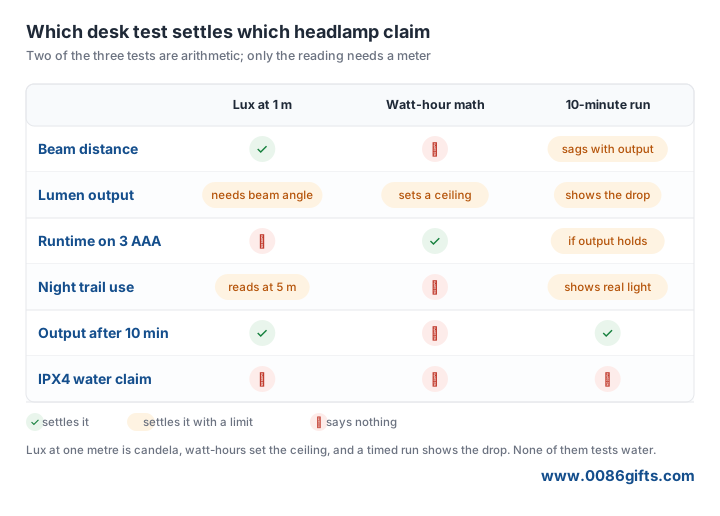
Two things these tests cannot tell you. Water resistance needs its own check: a splash from a bottle at the seams and the switch boot, then a look inside the battery compartment after an hour. And strap comfort is a wear trial, not a bench reading — a 90-gram lamp on a thin elastic band is a different product after two hours than it is in the hand. Measure the light on the bench, and put the rest on a person before you commit to a thousand.
Sourcing promotional gifts?
Send your item list and quantity for a quote and a digital proof.
Get a free quote