Metal USB Gift Sets: 5 Finishes and Their MOQ
The finish on a metal USB gift set is what the recipient judges first, but it is the last thing most buyers cost properly. Five finishes dominate the category — brushed, sandblasted, electroplated, powder coated and laser marked — and they are not interchangeable at any volume. Each one is a separate process with its own setup, its own batch size and its own way of failing in the recipient's hand.
Why the finish sets the minimum, not the drive
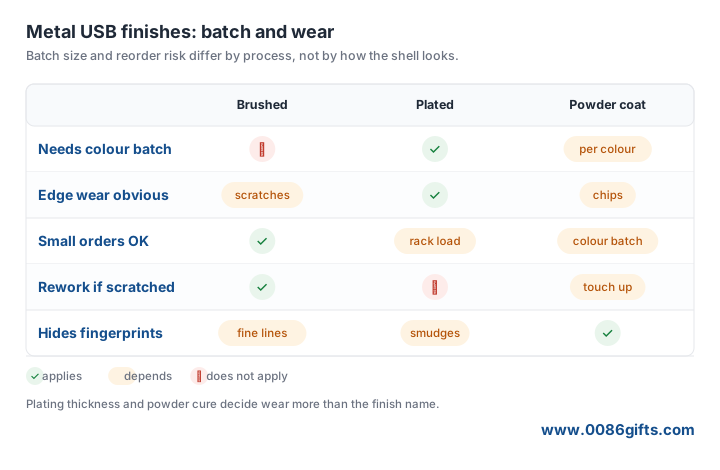
A metal USB body is usually a machined or die-cast shell with the flash board pressed inside. The electronics come in fixed capacities and are priced by chip; the shell is where the order becomes custom. Almost every finish is a batch process: parts are loaded onto a rack, a jig or into a drum, and the whole batch is treated together. That is why the minimum order for a brushed shell is small, while a plated or powder-coated shell pushes you toward a larger run — you are paying for a full rack or a full bath regardless of how many pieces you actually need.
Ask two questions before you choose: how many pieces fit a rack or a colour batch, and what happens to the price per piece when your quantity drops below it. A factory that answers both plainly is telling you its real constraint.
Brushed and sandblasted: the cheapest way to look expensive
Brushing cuts fine directional lines into the surface with an abrasive wheel. It is a mechanical finish on the base metal, so there is no colour to match and no bath to fill — the practical minimum is whatever the polishing bench can run in a day. What you must specify is grain direction and uniformity: a brushed shell with lines running in two directions looks like a defect under gift-box lighting, even though each line is within tolerance.
Sandblasting does the reverse. A stream of grit at 120 to 220 mesh opens a matte, even surface that hides fingerprints and small scratches, and it gives laser marking a clean contrast because the beam frosts rather than polishes. The trade-off is edge softness: blasting rounds the crisp chamfer that makes a small drive feel precise, so specify whether edges are masked before the blast.
Electroplating: colour consistency is the real cost
Plating deposits a metal layer — nickel, chrome, gold tone, gunmetal — onto the shell, usually 3 to 5 microns for decorative use over a nickel strike. Two things drive both price and risk. First, rack plating hangs each part individually and gives a cleaner finish on visible faces; barrel plating tumbles parts in bulk and is cheaper but can leave contact marks. Second, colour is a bath variable: nickel and gold-tone solutions drift as they are used, so a reorder six months later can arrive a shade away from the original.
That is why plated gift sets carry the highest effective minimum of the five finishes. You are not buying a small run of shells; you are buying a bath, a rack load and a colour standard that has to be re-established on every reorder. Keep a physical approved sample, not a photo, and record the plating thickness and the colour reference on the purchase order.
Powder coating: colour choice with a batch attached
Powder coating sprays a charged polymer onto the shell and cures it in an oven, typically 15 to 25 microns thick. It gives the widest colour range of any finish, including brand-specific shades and soft-touch matte, and it covers tool marks well enough to let you use a cheaper shell.
The constraint is the colour batch. A powder line runs one colour at a time and cleaning between colours costs setup time, so a buyer who wants four corporate colours on 500 pieces is effectively ordering four small batches, not one large one. Ask for the minimum per colour rather than the minimum per order. Also check the cure: an under-cured coat chips at the corners within a few weeks, and the symptom — flakes lifting at the port opening — appears long after the goods have shipped.
Laser marking: the finish dictates the contrast
Most metal gift drives are marked, not printed. Laser marking oxidises or frosts the surface and leaves a mark inside the material, so it does not peel. What changes between finishes is contrast, not durability. On brushed steel the mark reads dark against bright; on sandblasted aluminium it reads light against matte; on a dark powder coat it burns back to a pale grey that may be too subtle for a small logo.
That interaction is the reason finish and logo should be chosen together. A one-colour logo on a plated shell may need a pad print instead of a laser, and pad printing on a plated surface needs a primer or the ink wears at the edges. Test the combination on the actual finished shell: mark a scrap piece, rub it twenty times with a thumb, and look at the edge of the mark under a lamp.
Choosing a finish you can reorder
Buyers usually choose the finish that photographs best and then discover, on the second order, that the colour is a batch variable. The safer sequence is to pick the finish by how repeatable it is, then the colour by how forgiving it is.
Put the answer in writing on the order: finish name, base metal, coating or plating thickness, colour reference, and a named approved sample kept by both sides. Then specify the logo method against that finish rather than separately. When the second order arrives, compare it to the sample in daylight, not under office light, before the boxes go to the client.
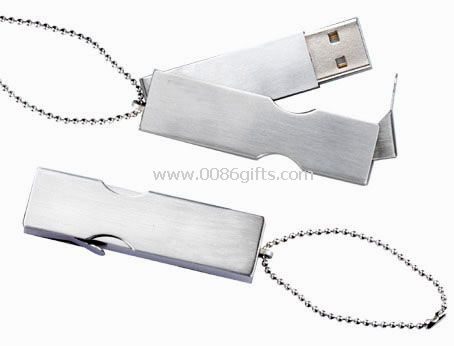
For gift sets that combine a drive with a box or a keyring, the shell finish is also the piece the recipient keeps, so it carries more brand weight than the packaging. Look through the metal USB flash drive range with the batch logic in mind: the shapes that take a brushed or blasted finish will reorder cleanly for years, while the plated statement pieces are better treated as a one-off campaign item.
Sourcing promotional gifts?
Send your item list and quantity for a quote and a digital proof.
Get a free quote