Power Bank Certifications for Corporate Gifts: CE, FCC, UN38.3
A power bank is the one item in a corporate gift programme that arrives with a shipping problem attached. It contains lithium cells, so it needs a transport test before any carrier will fly it, a declaration before any EU retailer will list it, and an FCC file before a US buyer will accept it. Buyers who treat those three as one "CE certificate" usually find out at the freight forwarder, three weeks before the event date.
Here is what each document actually covers, what it does not, and the arithmetic behind the capacity number on the box.
CE is a declaration, not a certificate
A power bank carries the CE mark because the manufacturer declares conformity with the directives that apply to it. For a plain 5 V output unit those are EMC — electromagnetic compatibility — and RoHS on restricted substances. The Low Voltage Directive generally does not reach a 5 V DC output device, and that is the first place buyers get confused: a supplier offering "CE LVD" for a 5 V power bank is describing a test that should not be the basis of the file.
If the unit includes wireless charging or a Bluetooth speaker function, the Radio Equipment Directive applies instead of EMC alone, and the file changes shape. Ask which directives the declaration of conformity names, then check that the list matches the product you are buying rather than a sibling model. A declaration of conformity is a one-page document signed by the manufacturer; the test reports behind it are what a retailer will ask for when a question comes up.
UN38.3 is about transport, and the test summary is the document
UN38.3 is the section of the UN Manual of Tests and Criteria that lithium batteries must pass before they can be offered for transport: altitude simulation, thermal cycling, vibration, shock, external short circuit, impact and overcharge. It is not a product safety mark and it says nothing about whether the bank will fail in a customer's bag. It exists so that a carrier can accept the box.
The document that matters day to day is the test summary, which carriers have required alongside the report since the air rules were tightened. Check that the summary names the cell, the pack model, the watt-hour rating and the test laboratory, and that the model on it matches the model on the invoice. Two related numbers decide your routing: a pack at or under 100 Wh can travel as a portable electronic device with the usual labelling, and above that threshold the airline approval path changes. An 11,000 mAh bank at a nominal 3.7 V works out to about 40.7 Wh, comfortably inside the first band.
State of charge is the other air-freight condition: cells and packs shipped as standalone cargo travel at no more than 30 percent charge. Your forwarder will ask you to confirm it, and a factory that fills batteries to full before packing creates a problem that gets discovered at the airport.
FCC Part 15 Subpart B, and the reports retailers add on top
For the US, a power bank is an unintentional radiator, so Part 15 Subpart B applies and the supplier provides a Supplier's Declaration of Conformity with the test report behind it. That is the legal floor. Above it sit two documents that are commercial rather than statutory: IEC 62133-2 for the safety of the lithium cell and pack, and UL 2056 for the power bank as an end product. Large US retailers routinely require both, and neither is satisfied by a CE file.
Ask for them early. A factory that has the IEC 62133-2 report on the cell it actually uses can produce it in a day; one that has to send cells out for testing will add weeks, and the schedule risk lands on your event date rather than theirs.
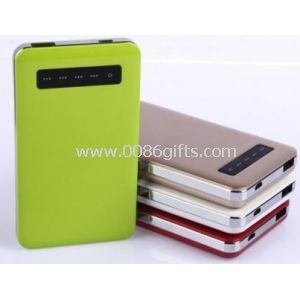
The capacity number on the box is not the capacity you get
Cell capacity is quoted at the cell's nominal voltage, usually 3.7 V. Output is 5 V. Converting one to the other is energy arithmetic: 11,000 mAh at 3.7 V is 40.7 Wh, and at 5 V that same energy is 8,140 mAh before any loss. Conversion efficiency in a boost circuit typically lands between 80 and 90 percent, so a well-built bank delivers somewhere around 6,500 to 7,300 mAh at 5 V.
That gap is why the honest figure on a gift-box spec sheet is the rated output capacity at 5 V, not the cell capacity. A phone with a 3,300 mAh battery therefore charges roughly twice from a good 11,000 mAh cell bank, not three times. If a supplier quotes a number that implies otherwise, ask for the discharge curve at 5 V and 1 A; the number on the label should match the area under that curve.
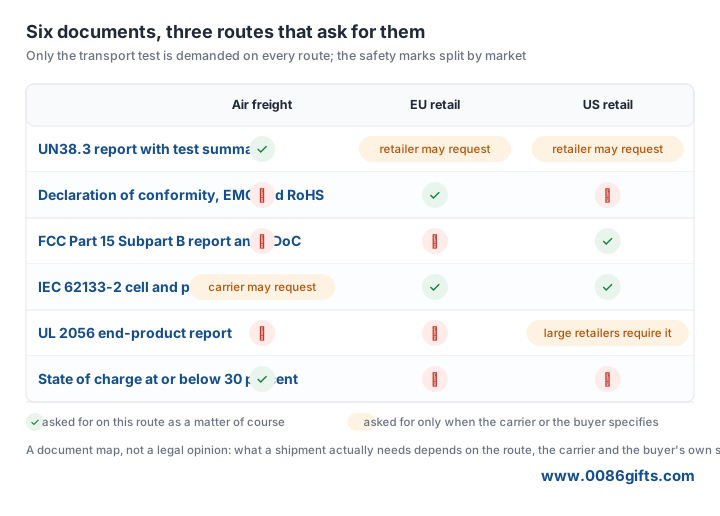
Put the document list on the purchase order
Write the file as line items and make each one a delivery condition: UN38.3 report with test summary naming the exact pack model; declaration of conformity naming EMC and RoHS, plus the Radio Equipment Directive if the unit charges wirelessly; FCC Part 15 Subpart B report with the supplier's declaration; IEC 62133-2 cell report; UL 2056 end-product report where the retailer requires it; a safety data sheet for the pack; and a signed statement that cargo ships at or below 30 percent state of charge.
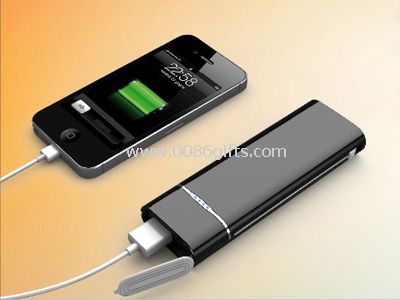
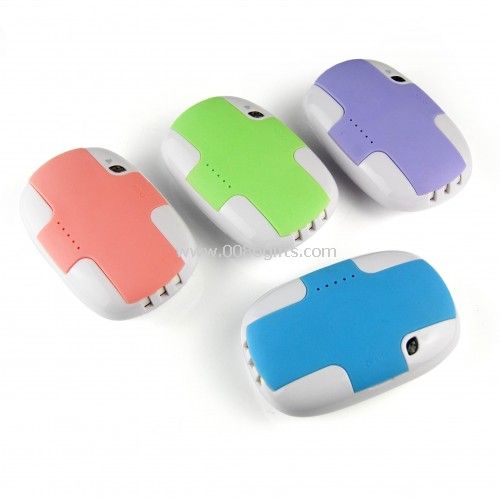
Then add the two checks that belong to the sample rather than the paperwork: measure the actual output capacity on one unit with a USB power meter under a 1 A load, and confirm that the printed rating plate carries the model, the watt-hour figure and the input and output ratings. A bank whose label omits the watt-hour figure will be stopped at the counter regardless of what the file says. The power banks category shows the formats these documents have to cover, from slim 2,100 mAh sticks to double-output packs.
Sourcing promotional gifts?
Send your item list and quantity for a quote and a digital proof.
Get a free quote